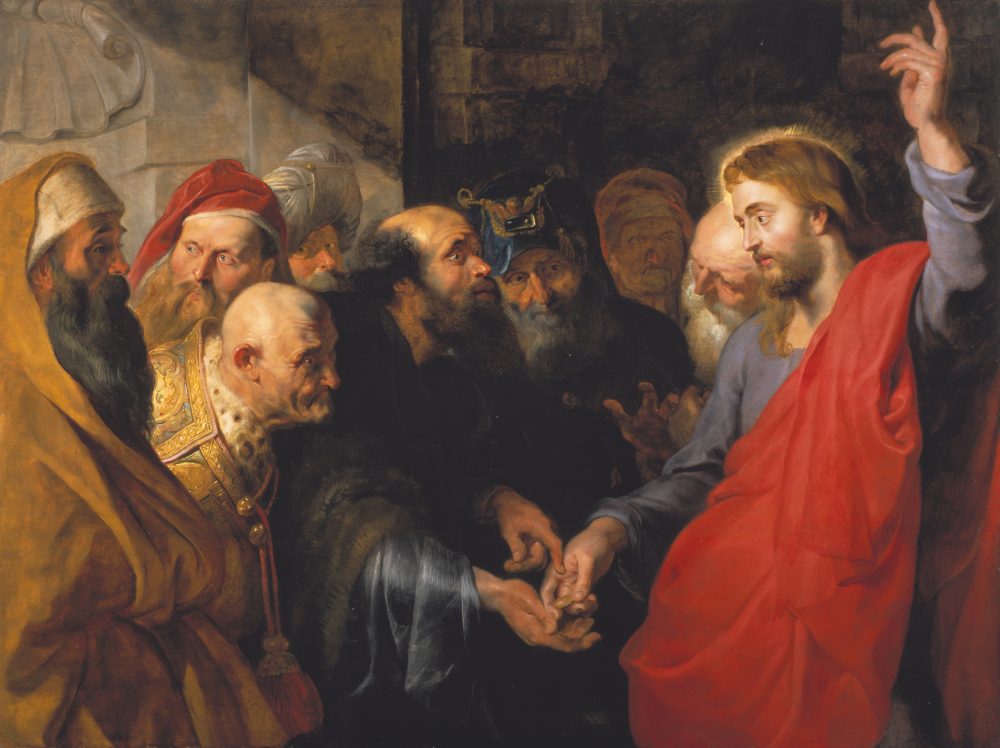
The Tribute Money
by Peter Paul Rubens
Sir Peter Paul Rubens (June 28, 1577 – May 30, 1640) was a Flemish Baroque painter, humanist scholar, and diplomat. He is celebrated as the most influential master of the Flemish Baroque style, known for his dynamic compositions, rich colors, and sense of movement.
Reflection on the Painting
“Render to Caesar the things that are Caesar’s, and to God the things that are God’s.” (Matthew 22:21)
Rubens does not set this well known scene in a cloister. Yet the crowded gathering may make us wonder what a disordered cloister might look like. There is no common stillness here: bodies press together, attention pulls in several directions, hands gather around the coin. Each person is near Christ, but nearness has not yet made them one.
The Cistercian cloister is shaped by common prayer, work, silence and obedience. Yet outward order does not guarantee inward concord. At times, the painting may mirror the interior heart of a community: affection tangled with rivalry, one brother intent on one thing while another looks elsewhere, a shared life whose centre risks becoming something other than Christ.
A Cistercian eye may recognise in the crowded company gathered around Christ in Ruben’s painting the inner life, where many voices compete for the heart’s attention. The coin draws the gaze downward, towards possession, power and the claims of the world. Yet the painting does not despise the world of matter. Christ’s hand is among the hands; he is present to the question asked in the midst of ordinary affairs. The call is not to flee the human encounter, but to let it be reordered by the presence of God.
Notice how the light falls unequally across cheeks, foreheads and half hidden faces. Some eyes meet the light, others remain in shadow. With the exception of Jesus, no one is fully disclosed to us. Notice also how Rubens’ use of light does not belong to Christ alone: it reaches into the company, touching those whose motives we cannot know. Perhaps this is a quiet image of grace. God’s light is already at work before a heart can explain itself.
The rich garments and gold embroidery speak of a world in which identity is made visible through rank and appearance. Christ’s red mantle, simpler in its fall, occupies the centre without effort. Its colour may draw the mind towards the Passion, towards the love that gives itself rather than defending its place. Bernard writes that “the measure of love due to him is immeasurable love.” The saying is not a demand to manufacture more feeling. It turns us towards the One who first loved us, and from whom every true act of charity is received.
Christ’s two gestures hold the scene together. One hand remains beside the coin; the other lifts the gaze. Jesus neither denies the question nor allows it to become the whole horizon. Caesar’s likeness is stamped on the coin; the human faces around it bear the image of God. What has been impressed upon that image by fear, pride, rivalry or the need for approval? What might be uncovered as the heart turns again towards its Source?
Here our Cistercian vows become ways of bearing Christ’s image in the world. Stability is the patient consent to remain: with God, with the brothers, with the real people whose faces are not always easy to receive. Conversion of heart is the daily turning from the coin that would command our attention to the Father whose likeness we bear. Obedience begins in listening, in making room for the Word, and each other, before insisting upon our own way. These are not ornaments of a religious life. They are the slow work by which Christ becomes visible in it.
Through the Rule of St Benedict (and A6 of our own rule) we are called to prefer nothing whatever to Christ, and that his life, lived singly and together, become a quiet witness to the Gospel. Yet we are also reminded that a brother is not the light but merely a messenger of the One who is Light. It is through a life committed to learning silence, patience, humility, charity, courage and prayer, that another may glimpse the love of the Redeemer in our daily walk with Christ as dispersed Cistercians outside the cloister. In Rubens’s painting, Christ does not overwhelm the faces around him. He attends to them, and points beyond himself to the Father in much the same way as we are called to present Christ to the world.
Rubens’ painting leaves us with some questions to contemplate. What does it mean to give God what belongs to God? The answer, of course, begins in the life received from God, and in the slow restoration of his likeness; in a heart made obedient by love, stable in mercy, and always being converted towards Christ.

